Low Profile Clicky Switches are no longer a niche choice for a small group of keyboard users. In 2026, they sit at the meeting point of portability, speed, and clearer typing feedback. The broader market context explains why this topic matters. Grand View Research projects the gaming keyboard market to grow from USD 1.11 billion in 2024 to USD 1.88 billion by 2030. This growth signals a broader change in user expectations. Buyers are no longer satisfied with compact form alone. The market now expects thinner keyboards to balance reliable performance with clear and memorable typing feedback.
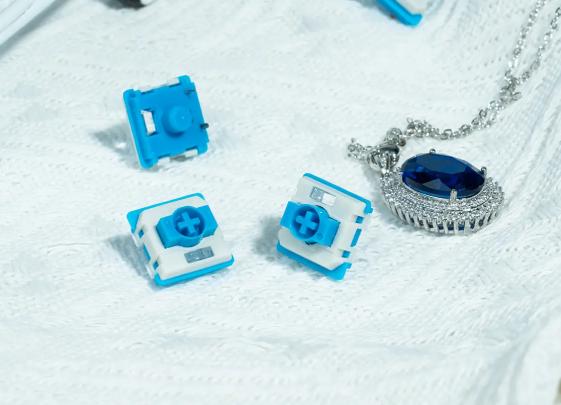
Why Low Profile Clicky Switches Matter in 2026
The current keyboard market is shaped by mobility and desk efficiency. Thinner devices, smaller layouts, and faster daily workflows have changed what users expect from a switch. Many buyers do not want a tall keyboard with a heavy visual footprint. They want a slimmer board that feels precise and still offers a distinct sense of actuation. This is where Low Profile Clicky Switches create a clear position.
At GATERON, we see this demand as more than a style preference. It is an engineering challenge. A low-profile structure reduces vertical height and shortens movement, but the switch must still feel intentional under the finger. If the tactile event is weak, the switch can feel vague. If the click is too sharp, the sound can become thin rather than satisfying. For this reason, the internal leaf mechanism becomes one of the most important design points in a clicky low-profile product.
What the Leaf Mechanism Actually Does
The click in a mechanical switch is not created by sound alone. It begins with force control inside the switch. In a clicky structure, the leaf helps manage contact, resistance, and the timing of the tactile event. When this mechanism is tuned correctly, the user does not only hear the click. The user also feels a defined moment of actuation.
In practical terms, the leaf mechanism helps determine several core performance traits:
✓ Tactile timing — when the finger senses the bump during travel
✓ Click consistency — whether each keystroke sounds uniform across the board
✓ Electrical reliability — how steadily the contact is made during repeated use
✓ Return character — how cleanly the switch recovers after bottom-out
This is why the leaf should not be treated as a minor internal part. It is central to the typing identity of Low Profile Clicky Switches. GATERON has also highlighted leaf durability in its switch development, noting the use of oxidation-resistant gold contacts in the leaf structure on certain products to support longer service life and improved resistance to oxidation.
Why Low Profile Clicky Switches Are Harder to Engineer
A standard-profile switch gives designers more internal space. A low-profile switch does not. That difference affects almost everything. Travel is shorter, packaging is tighter, and force transitions must happen within a smaller range of motion. Because of that, designing Low Profile Clicky Switches is not simply a matter of shrinking a conventional clicky switch.
The engineering target is more demanding. The click must arrive at the right point in travel. The leaf must respond quickly but remain stable. The switch also needs to avoid an overly hollow or overly harsh tone. In low-profile products, small structural adjustments can produce noticeable changes in feel and sound.
GATERON's low-profile product line reflects this direction. The company describes its low-profile switches as supporting thinner keyboard builds, faster actuation, and more comfortable long-session use. Official product information for the KS-33 family also shows that the low-profile format is developed around compact geometry rather than being treated as a reduced-height version of a normal switch.
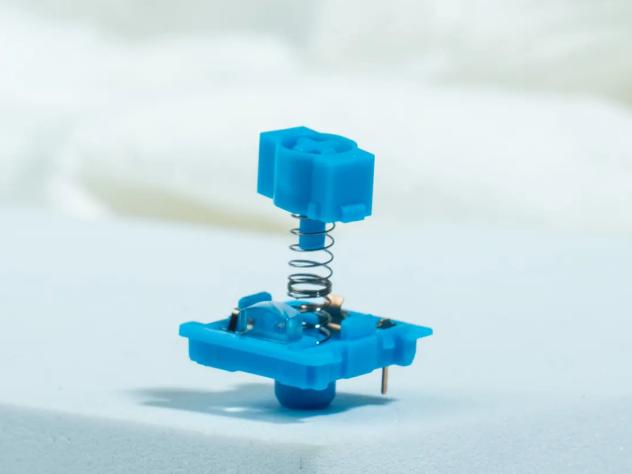
A Closer Look at GATERON's Low Profile Bamboo Clicky
For readers who want a concrete product example, the GATERON KS-33 Low Profile Bamboo Clicky Switch offers a useful case. According to GATERON's official product page, it is a clicky switch with 60±15gf operating force, 1.7±0.5mm pre-travel, and 3.0±0.2mm total travel. It uses a POM stem, POK top housing, POM bottom housing, 3-pin structure, and comes pre-lubed with SMD LED support.
These figures matter because they show how GATERON approaches the balance between compact travel and pronounced feedback. A 3.0mm total travel is short enough to suit slim keyboard architecture, but still long enough to avoid an overly abrupt feel. The 1.7mm pre-travel helps position the tactile and click event early enough to feel responsive, which is especially useful for users who want quick confirmation in typing-intensive tasks.
From a product-planning perspective, this kind of switch can suit several user groups:
✓ Users who want a compact keyboard without giving up audible confirmation
✓ Builders seeking a stronger personality than silent or linear low-profile options
✓ Brands developing slim mechanical boards for office, creator, or enthusiast markets
For clients evaluating switch options, the key point is not only the published numbers. It is how those numbers align with the intended keyboard identity. A low-profile board built for quiet shared offices needs one solution. A board designed to express mechanical character needs another.
How to Evaluate Low Profile Clicky Switches as a Buyer
When clients evaluate Low Profile Clicky Switches, they should look beyond the word “clicky.” The real question is whether the switch delivers controlled feedback in a slim structure. A useful evaluation process should include both technical and commercial factors.
First, review whether the click character is likely to remain clear in a compact board design. Low-profile keyboards often use thinner cases and different plate conditions, so the acoustic result can change significantly. Second, check whether the operating force and pre-travel support the target use case. Third, consider compatibility and replacement logic, because some low-profile switch families are designed for specific keyboard ecosystems. GATERON, for example, notes that the KS-33 low-profile switch family is intended for keyboards built to fit GATERON low-profile switch structures.
This is also where a manufacturer's development capability becomes important. Buyers increasingly need more than a switch catalog. They need a supplier that understands how sound, travel, materials, and platform compatibility work together in the final product. That is especially relevant in a market where compact layouts and performance-oriented keyboards continue to gain attention.
The Future of the Click Starts With Better Internal Design
At GATERON, we believe the future of Low Profile Clicky Switches depends on disciplined internal engineering rather than superficial novelty. The leaf mechanism remains one of the most decisive elements because it shapes the moment that users remember most: the point where touch, sound, and actuation meet.
As the mechanical keyboard market continues to expand, buyers will become more selective about what “good click” actually means. They will not only compare noise levels. They will compare timing, sharpness, return feel, and long-term consistency. That makes internal structure more important than marketing language.
For brands, designers, and sourcing teams, this creates a practical opportunity. A well-developed low-profile clicky switch can help a keyboard stand out in a crowded market while still matching modern demands for slimmer form factors and faster response. For readers exploring their next project, now is the right time to study GATERON's low-profile switch range and compare how different force curves and structures support different keyboard goals. The right click is not accidental. It is designed. For product consultation, switch sampling, or low-profile project support, GATERON offers a useful starting point through its official low-profile series and product references.



