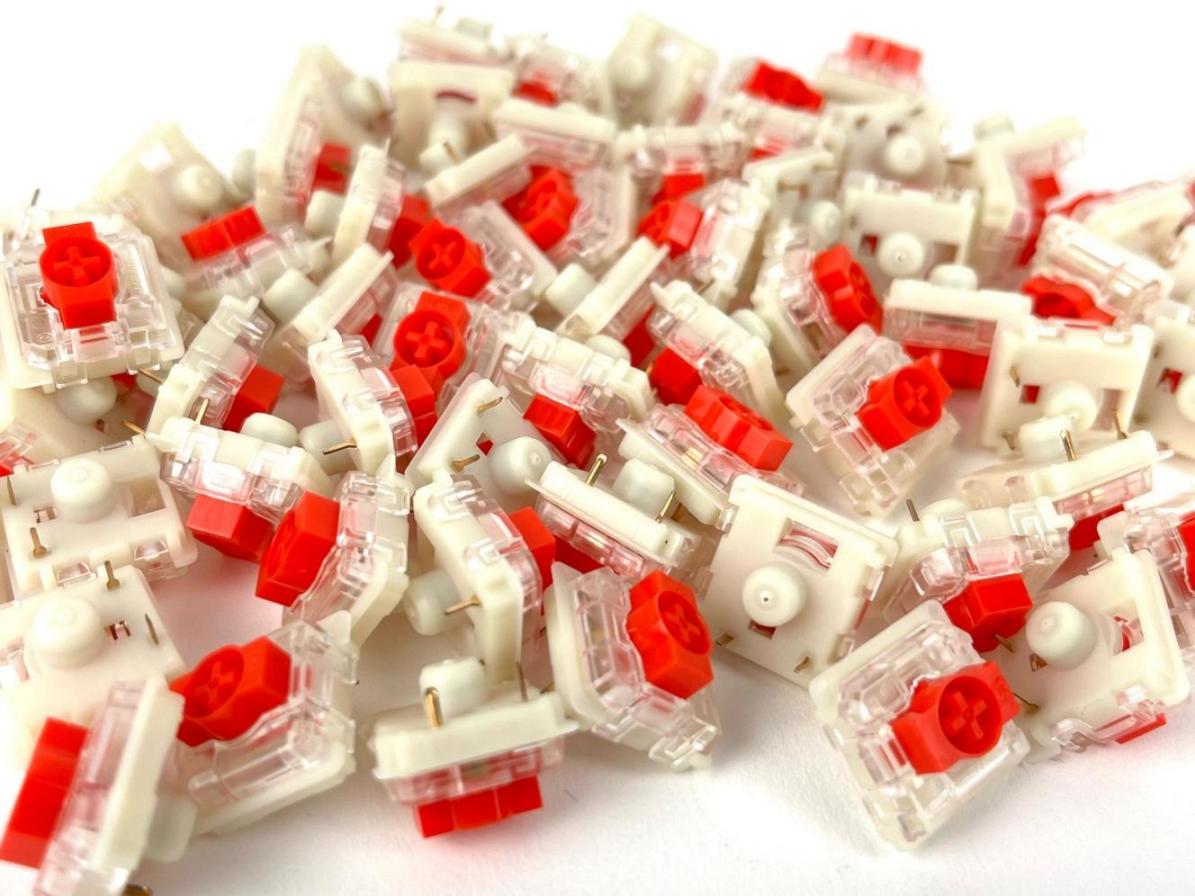
Low Profile Tactile Switches are designed to be housed in a more compact structure, which provides a mid-press bump that improves typing accuracy. These switches are an integration of a full-travel mechanical keyboard and a traditional slim laptop keyboard. As of 2026, these switches are capable of faster, quieter and more controlled keystrokes, making them a viable option for both typists and gamers.
How Low Profile Tactile Switches Actually Work
To understand Low Profile Tactile Switches, it helps to first understand what "tactile" means in the mechanical keyboard context. A tactile switch gives a noticeable mid-press bump that tells you the switch has engaged. This helps many typists reduce bottoming out, type with more control, and maintain a steady rhythm.
With Low Profile Tactile Switches, the engineering challenge is that everything happens in a shorter vertical space. Travel distance is reduced, so the tactile event must be engineered to feel clear without becoming harsh or jarring. A tactile low-profile switch should feel:
✅ Predictable: Every press should meaningfully show the bump.
✅ Clean: The bump should be defined without vagueness or scratchiness.
✅ Comfortable: Long sessions should be painless.
Low-Profile Tactile Switches produce a tactile feel due to the stacking of the geometry of the spring and the bump due to the internal system of the leaf. When the key is pressed, the stem passes over the leaf spring. This spring offers resistance to the stem until the spring passes the point of no return, and the spring snaps. This, to the finger, is the tactile bump signifying the key has been pressed.
Low Profile Tactile Switches in 2026
Since 2022, the U.S. has not looked the same. With 22% of the U.S. population (about 32.6 million people) working full or partially from home, the way we used to think of work is not true anymore. It has expanded into co-working venues and remote places of business. Mechanical keyboards fail to provide tactile response, are bulky and impractical. Laptop keyboards are even less of a solution.
Low Profile Tactile Switches offer:
- Improved Ergonomics: A shorter profile lowers bulk and offers a more efficient use of space. This inherently positions wrists more comfortably.
- Portability: These low-profile switches are designed specifically for compact keyboards. They become a portable typing solution along with your laptop and allow you to work at different places throughout the day.
- Typing efficiency: Keys that have a travel of 2.5mm and 3.2mm are easier to type on and travel a shorter distance. Less distance between each key press allows the user to type for a longer period of time without the feeling of fatigue setting in.
- Noise reduction: Low-profile tactile switches are better at controlling sounds than the full-height standard switches. This makes them easier to use in an office environment with a lot of coworkers without being disruptive.
The ease of use and efficiency of Low Profile Tactile Switches can be further improved with hot-swappable PCB sockets. Hot-swap technology allows users to insert and remove switches without soldering, which means:
- Beginners can build their first custom keyboard with minimal tools and technical knowledge
- Enthusiasts can test different switch feels side by side on the same board
- Users can mix switch types across the keyboard—placing linear switches under gaming keys and tactile switches under the home row for typing, all on the same keyboard
GATERON's Approach to Low Profile Tactile Switches
GATERON has been refining low-profile switch geometry, stabilizer alignment, and smooth travel for years. The result is a product line that meets the demands of both high-volume keyboard manufacturers and individual custom builders.
1) KS-27: The First Generation
The GATERON KS-27 represents the first generation of GATERON low-profile switches with a cross stem. Right out of the box, you can enjoy a comfortable typing experience with the double-stage spring and factory pre-lubrication.
Think of the KS-27 Low Profile Tactile Switch as follows:
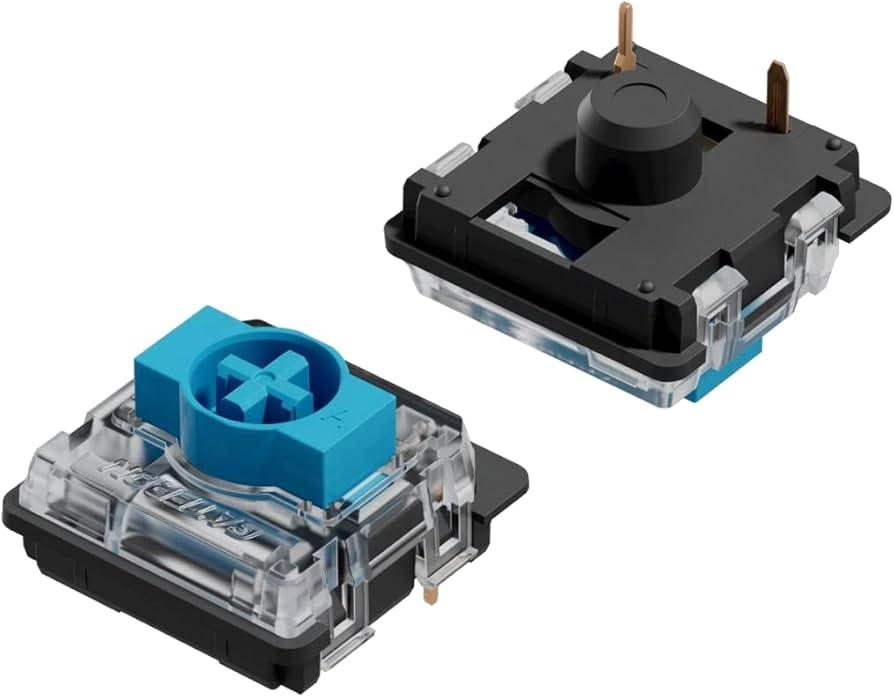
- Total travel: 2.5 + 0.5 / - 0.0 mm
- Lifetime: 50 million keystrokes
The KS-27 has a fast finger feel and is a great option if you’re upgrading from a standard laptop keyboard to a low-profile mechanical keyboard.
2) KS-33 Low Profile 2.0: The Second Generation
Taking the KS-27 to the next level, GATERON released the KS-33 Low Profile 2.0, otherwise known as the second generation of GATERON low-profile switches.
Significant developments with the KS-33 include:
- Height increased to 12.2 mm for wider compatibility with keycaps
- Pre-travel increased to 1.7 ± 0.4 mm, which provides a similar feel to normal-profile switches with a faster actuation
- Total travel increased to 3.0 ± 0.2 mm, offering a sensible reduction in accidental keystrokes while maintaining a dynamic keystroke feel.
- Lifetime Increased to 60 Million Keystrokes
- Shorter side poles (0.3 cm reduced) and longer middle stem poles (0.3 cm extended) for a more solid bottom-out feel
The KS-33 Low Profile 2.0 switch makes use of a POM stem for smoothness, a transparent PC top housing for SMD LED support, with a nylon bottom housing (available in black and white) for structural integrity.
If you want even more of a tactile feel, GATERON has the KS-33 Banana option. The Banana is a heavier and much more tactile switch than the average low-profile brown switch. This is great for focused typing, as it reduces accidental key presses and adds a tactile feedback switch that brings you closer to a full-height tactile switch.
KS-33 Keycap Compatibility
One of the most impressive aspects of the KS-33 Low Profile 2.0 series is its keycap versatility. KS-27 models only support low-profile keycap sets. The KS-33 allows you to use even more profiles, including:
- Low-profile sets (NuPhy nSA, Keychron LSA, XVX)
- Tall profiles (MT3, SA, Cherry, OEM, XDA, MDA, MA)
With this accessibility, designers and manufacturers are given more room to innovate as they won't be limited by a small (possibly undesirable) keycap selection, as KS-33 users have a much bigger pool of keycap sets and materials to play with.
Final Words
Low-profile tactile switches are becoming the default for hybrid work. No longer a compromise, they now deliver reliable tactile feedback thanks to improved design and materials. Today’s low-profile keyboards match full-height models in responsiveness and durability. GATERON continues refining the balance of feel, durability, and compatibility for next-generation boards.
Whether you source components for a product line or build your own keyboard, these switches offer better typing in a slimmer form. To learn more about GATERON’s KS-27 and KS-33 Low Profile Tactile Switches, visit the official product pages for details.
Frequently Asked Questions
Q: Are low-profile tactile switches able to function with conventional PCs’ mechanical keyboard PCBs?
A: Most low-profile switches need specially designed PCBs that have low-profile footprints. Many of the new hot-swappable boards, however, have both the standard and low-profile layouts. Always ensure the compatibility of the PCB before you buy.
Q: Is the tactile sensation of Low Profile Tactile Switches the same as that of a full-height tactile switch?
A: They are similar in feeling, but the travel distance is shorter. The tactile bump is still present and is well-defined. Due to the key travel distance, it is fast and responsive.
Q: Can I use standard keycaps on Low Profile Tactile Switches?
A: No. The stem design is different; as a result, it is shorter. GATERON’s KS-33 is different, and in this case allows multitude of keycap profiles, which can be DSA, DSS, OEM, and Cherry.
Q: Are Low Profile Tactile Switches fit for use in gaming?
A: Yes. The short travel distance and the fast return are good for fast key presses. The tactile bump is good for precise timing of abilities to help avoid accidental key presses.
Q: What is the durability of GATERON’s Low Profile Tactile Switches?
A: GATERON states that its KS-27 switches can withstand 50 million keystrokes, and KS-33 switches can withstand 60 million keystrokes, which matches or even surpasses many full-height switches available in the market.



